Leadership
Why Most Struggles Aren’t About Skills — and What Really Needs to Change
Over the last couple of years of coaching, I’ve noticed something interesting: many of the challenges people bring aren’t primarily about decisions, goals, or confidence. Instead, they are about the inner lens through which a person is living and making sense of the world.
This isn’t just semantics. It’s a big shift in how we understand growth, maturity, and transformation.
There’s a school of thought in leadership psychology — associated with Robert Kegan, Lisa Lahey, and their collaborators — known as vertical development. At first glance, it might sound theoretical and academic. But once you strip away the jargon, the idea is surprisingly simple and deeply human:
We don’t just grow by adding skills. We grow by changing how we see ourselves and reality.
In other words, personal development isn’t just about what we can do. It’s about who we are now versus who we can become.
When I look at how people actually experience growth, I often think about it in three relatable layers of selfhood:
🔹 The Dependent Self
In this mode, a person’s choices and actions are shaped largely by external expectations.
- “What will others think?”
- “Am I doing it right?”
- “I need approval to feel safe.”
Decisions tend to be guided by:
- fear of judgment,
- desire to belong,
- staying within familiar frameworks.
Dependent selves are capable and competent. But they often live from the outside-in — their inner compass is calibrated by others.
This isn’t a flaw. Everyone starts here.
🔹 The Independent Self
At this stage, authorship begins.
“I decide what matters to me.”
Here, people start:
- clarifying their values,
- setting personal boundaries,
- taking ownership of choices,
- and trusting their own inner authority.
There’s a shift from “What would others expect?” to “What matters to me?”
The Independent Self is powerful: it brings clarity, autonomy, and purpose. But it can still be trapped within a “self-contained” view — focusing on personal achievement, goals, or self-direction without necessarily seeing broader patterns or impacts.
🔹 The Interdependent Self
This is where vertical development becomes most visible in real life.
An interdependent person:
- sees systems instead of isolated problems,
- holds complexity without collapsing it into simplicity,
- and makes decisions with awareness of long-term and collective impact.
Here, truth is not binary. Identity is not fixed. Perspective is multi-layered.
Don’t think about is as being “better” than others — it’s about a different way of processing reality. It’s the shift from me → me in relation to others and contexts.
Why So Many Struggles Aren’t About Lack of Ability
What I find fascinating is that often, people don’t struggle because they lack capacity. They struggle because they are trying to solve next-level challenges with previous-level thinking.
A leader might be great at setting goals and driving execution — yet repeatedly stumble when something requires empathy, perspective-taking, or embracing complexity.
A professional may be highly skilled but feel stuck when the next step calls for meaning rather than mastery.
A parent may confidently manage logistics but struggle when the moment asks for emotional presence.
These are not issues of technique or willpower — they are issues of perspective.
Sometimes, the question isn’t:
“What should I do next?”
It’s something more subtle and more human:
“From what way of being am I trying to act?”
Practical Ways to Notice Where You Are — and Grow
If this idea resonates, here are some simple, real-world practices to help you notice — and expand — your inner lens:
1. Notice the why behind your choices
Before deciding what to do:
- ask why you want it,
- ask what emotion or expectation is driving that desire,
- ask who or what you are trying to satisfy.
This reveals whether you’re acting from dependency (external validation), independence (internal standards), or interdependence (contextual awareness).
2. Track the default perspective under stress
Stress reveals your deepest operating system. When things get tense, notice:
- Do you default to pleasing others?
- Do you push harder for control or autonomy?
- Do you pause, curious about multiple possibilities?
Your stress response often signals your current stage of meaning-making.
3. Ask system-level questions
When confronting a challenge, widen the lens:
- Who else is part of this system?
- What patterns have shown up before?
- What unintended consequences might follow my choice?
These questions cultivate the interdependent mindset.
4. Reflect on transitions, not just outcomes
Growth isn’t linear.
Sometimes things don’t work not because you failed, but because your way of seeing has already changed.
Instead of asking:
“Why didn’t I achieve this?”
Try asking:
“What way of seeing has stopped working for me?”
This reframes frustration into developmental insight.
The Heart of Vertical Development
At its core, vertical development is about:
- moving from being shaped by the world to self-authorship to participating in the world with wisdom and context.
No, it’s not about being “better.” It’s about becoming more capable of holding complexity — and responding from that expanded capacity.
One of the clearest ways this idea is expressed, in a sentence so simple it can fit on a poster or a slide, is:
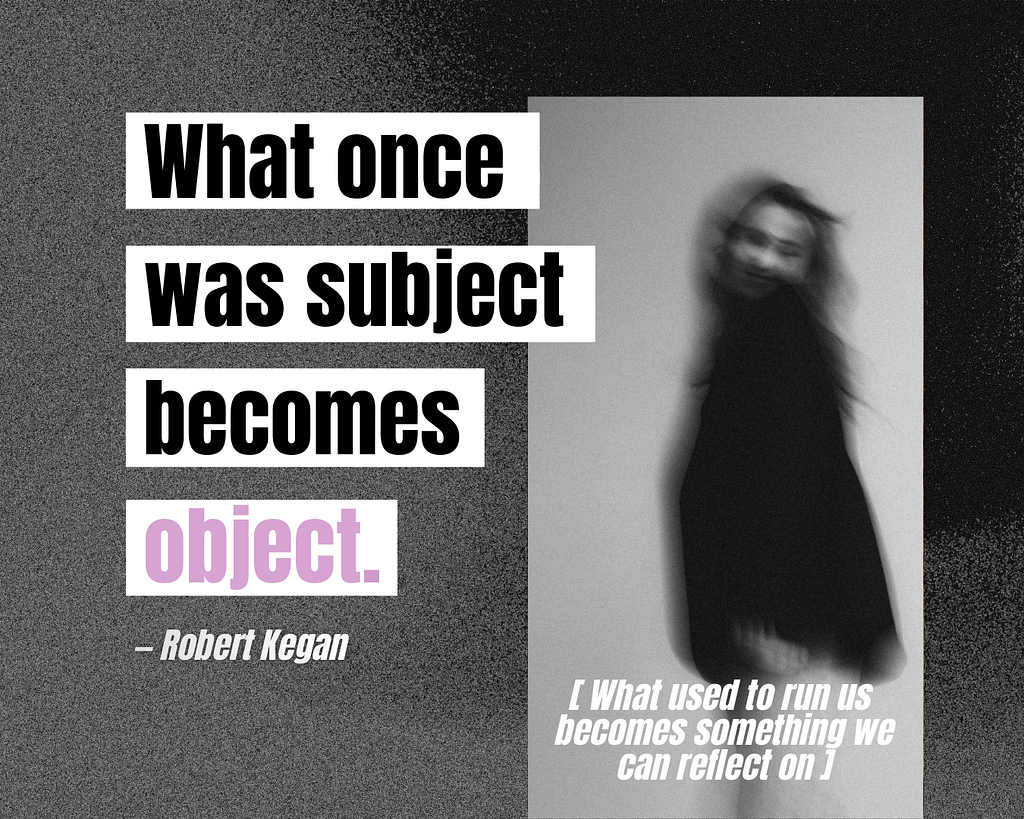
“What once was subject becomes object.” — Robert Kegan
Meaning: what once controlled you from the inside becomes something you can step back from and observe.
And this, truly, is where transformation begins.
Ready to talk through your own transition?
Book a free 30-minute discovery call and let's explore what's next.
Book a Free Discovery CallFree Resource
Get the Career Pivot Playbook
A practical guide with 5 frameworks to help you navigate your next professional move with clarity and confidence.
The "Stay or Go" Decision Matrix
The 5 Signs You're Ready for a Change
The Career Clarity Framework
The Pivot Ladder & the 70% Rule
Your 7-Day Next Steps Action Plan
Download Your Free Guide
Enter your email and we'll send you the Career Pivot Playbook instantly.