Leadership
When It’s Not You. And It’s Not Them. It’s the Interaction.
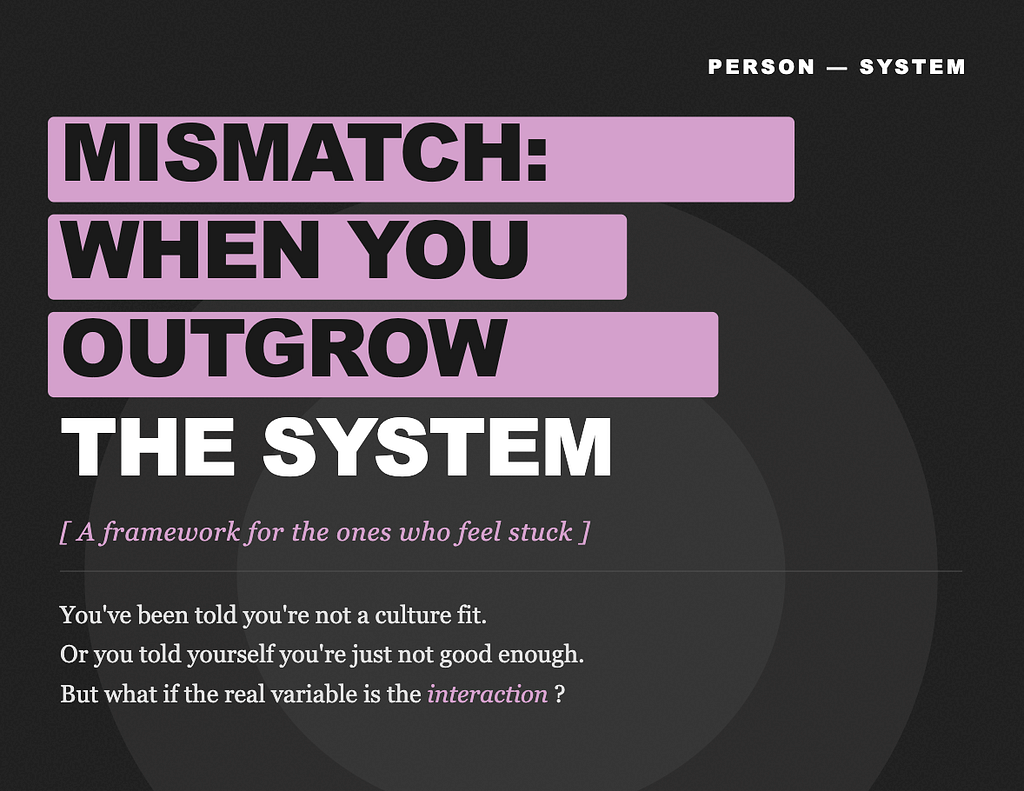
A coaching framework for talented people who feel quietly suppressed — and can’t figure out why
The conversation that changed how I think about this started with a sentence I’ve heard dozens of times in different forms:
“Maybe I’m just not good enough for this place.”
My client — sharp, thoughtful, genuinely capable — had spent eighteen months trying to adapt. She’d softened her directness. She’d stopped challenging certain decisions. She’d learned who could handle feedback and who couldn’t. She’d made herself smaller, bit by bit, in ways so gradual she hadn’t noticed until one day she looked up and didn’t quite recognise herself.
And she was exhausted.
Here’s what the standard narrative offers when something like this happens: either you’re the problem, or the company is. Either you’re not resilient enough, not flexible enough, not strategic enough — or the organisation is toxic, the culture is broken, the leadership is bad.
Both framings have something in common: they’re clean. Blame lands somewhere. The story makes sense.
But they miss a third variable. One most people never stop to name.
The interaction between your level of development and the system’s level of complexity.
Person — System Mismatch
Robert Kegan, the developmental psychologist, spent decades studying how people grow in their capacity to think, relate, and hold responsibility. His work suggests that development isn’t just about skills or knowledge — it’s about the complexity of the meaning-making structures we bring to situations. Those structures evolve over a lifetime. And not everyone around you is at the same stage.
Edgar Schein, the organisational thinker, showed something equally important from the other direction: systems aren’t neutral containers. They operate on deep, often invisible assumptions about what success looks like, how power works, what loyalty means, and how much uncertainty people are allowed to hold. These assumptions are rarely written down. But they run everything.
When those two — your developmental stage and the system’s operating logic — don’t match, something happens. Not dramatic. Not obvious. Just a low, persistent friction. A sense that you’re playing a game the rules of which no one will explain, because no one has named them.
That friction has a name: person-system mismatch.
And in my experience, it creates three distinct types of silent suffering.
Mismatch #1: Complexity
Your ability to process ambiguity, integrate perspectives, and hold responsibility — exceeds, or is exceeded by, the system’s structure.
When you’re more complex than the system, you’re bored in a way that’s hard to articulate without sounding arrogant. You can see the problems, you can hold the contradictions, and you’re not being asked to. So you disengage. Or worse, you pathologise your own restlessness.
When the system is more complex than you, you’re overwhelmed. Not because you’re incompetent — but because the level of ambiguity, the pace of change, the breadth of responsibility genuinely exceeds what you can process right now. That gap is closable. But not by pretending it doesn’t exist.
The result, in both directions: boredom or overwhelm. And often, a quiet but corrosive self-doubt.
Mismatch #2: Values
Your internal compass conflicts with the organisation’s implicit rules.
This is not about posted values on a wall. It’s about the unspoken logic that actually governs decisions. Who gets rewarded. What gets said in rooms and what doesn’t. Whether dissent is genuinely welcome or merely tolerated when it arrives politely enough not to threaten anything.
You care about meaning and integrity. The system optimises for metrics and optics.
The result: inner tension, self-doubt, moral fatigue. A creeping sense that you’re compromising yourself in small ways every week. And the slow, demoralising question of whether that’s just what maturity looks like.
It isn’t.
Mismatch #3: Psychological Safety
You may be fully capable, and even aligned with the stated values — but the environment does not allow for experimentation, dissent, or vulnerability.
Amy Edmondson’s research on psychological safety is clear: teams that can afford to be wrong learn faster, perform better, and retain their best people longer. In environments where safety is absent, even the most capable person self-contracts. You shrink. You speak less. You take fewer risks. You calibrate everything to what’s survivable. And over time — this is the part that’s hardest to see — you start calling that professionalism.
The result: self-contraction dressed up as adaptation.
These three mismatches are not the same thing. Complexity mismatch is about cognitive fit. Values mismatch is about moral fit. Psychological safety mismatch is about relational fit. They can overlap, and they often do — but they require different responses.
Naming which one you’re in matters more than it sounds. Because if you treat a values mismatch like a complexity mismatch, you’ll spend years developing skills when what’s actually needed is a different conversation — or a different context entirely.
Here is what I know to be true, after sitting with this in hundreds of coaching conversations:
Growth is possible even in a limited system.
But growth is not possible where you must shrink yourself to survive.
Those are not the same situation. And the difference is worth knowing.
The question I sit with — and that I hope my clients are beginning to sit with — is a more nuanced one than should I stay or should I go?
It’s this: Is this system stretching me, or have I already become bigger than what it can hold?
Because one of those is a discomfort worth tolerating. And one of those is a signal worth trusting.
Inspired by the work of Robert Kegan (adult development theory), Edgar Schein (organisational culture), and Amy Edmondson (psychological safety). This is the first in a series of posts exploring person-system mismatch — recognising it, navigating it, and deciding what to do with it.
Ready to talk through your own transition?
Book a free 30-minute discovery call and let's explore what's next.
Book a Free Discovery CallFree Resource
Get the Career Pivot Playbook
A practical guide with 5 frameworks to help you navigate your next professional move with clarity and confidence.
The "Stay or Go" Decision Matrix
The 5 Signs You're Ready for a Change
The Career Clarity Framework
The Pivot Ladder & the 70% Rule
Your 7-Day Next Steps Action Plan
Download Your Free Guide
Enter your email and we'll send you the Career Pivot Playbook instantly.