Professional Growth
The Fear of AI Isn’t About Losing Work — It’s About Losing Meaning
A few days ago, I listened to an episode of The Anxious Achiever podcast that hasn’t left me since. Not because it was about technology. But because it was about people - and the emotional weight that AI is placing on them.
We talk so much about adoption, tools, productivity, efficiency. But underneath all those polished words, something much more human is happening. Something we rarely acknowledge.
This article is my attempt to put those unspoken parts into words.
1. The real challenge isn’t AI. It’s what people feel when AI enters their world.
When organisations say they struggle with AI adoption, they usually point to:
- lack of training
- lack of the right tools
- lack of clarity
- lack of strategy
But the conversation I heard made something very clear:
AI adoption is not hard because AI is difficult. AI adoption is hard because human emotions are difficult.
People aren’t fighting technology. They’re fighting the feelings that technology awakens in them.
Feelings like:
- anger
- anxiety
- grief
- confusion
- a sense of being “less needed”
- a quiet fear of becoming invisible
These are not “barriers to adoption.” These are human responses to loss — or the anticipation of loss.
Companies often move straight to tools, workflows, and metrics. But none of that matters if people are silently grieving something essential to who they are.
This is why psychological safety matters. Adoption without emotional processing simply doesn’t happen.
2. The people who hurt the most are the people who love their craft.
This part hit me hardest.
The ones who are most shaken by AI aren’t the disinterested or the disengaged. They’re not the people waiting for a shortcut.
The people who struggle most are those who have built a life around their craft:
- coders
- designers
- writers
- analysts
- architects
- creators of all kinds
These are people whose work has never been just work. It has been:
- their identity
- their sense of mastery
- the place where they feel alive and capable
- their contribution to the world
- a source of pride
- the meaning that holds their day together
When AI steps into their field, it doesn’t simply automate tasks. It touches something much more tender.
It threatens the craft — and with it, the meaning tied to the craft.
This is why the emotional reaction is so strong. It’s not irrational. It’s not dramatic.
It’s the kind of pain that comes when something you love is suddenly at risk.
And for many people, their craft is their meaning. Not in a poetic way — in a deeply personal one. It is where they have invested years, attention, talent, heart.
Of course they feel fear. Of course they feel anger. Of course they feel grief.
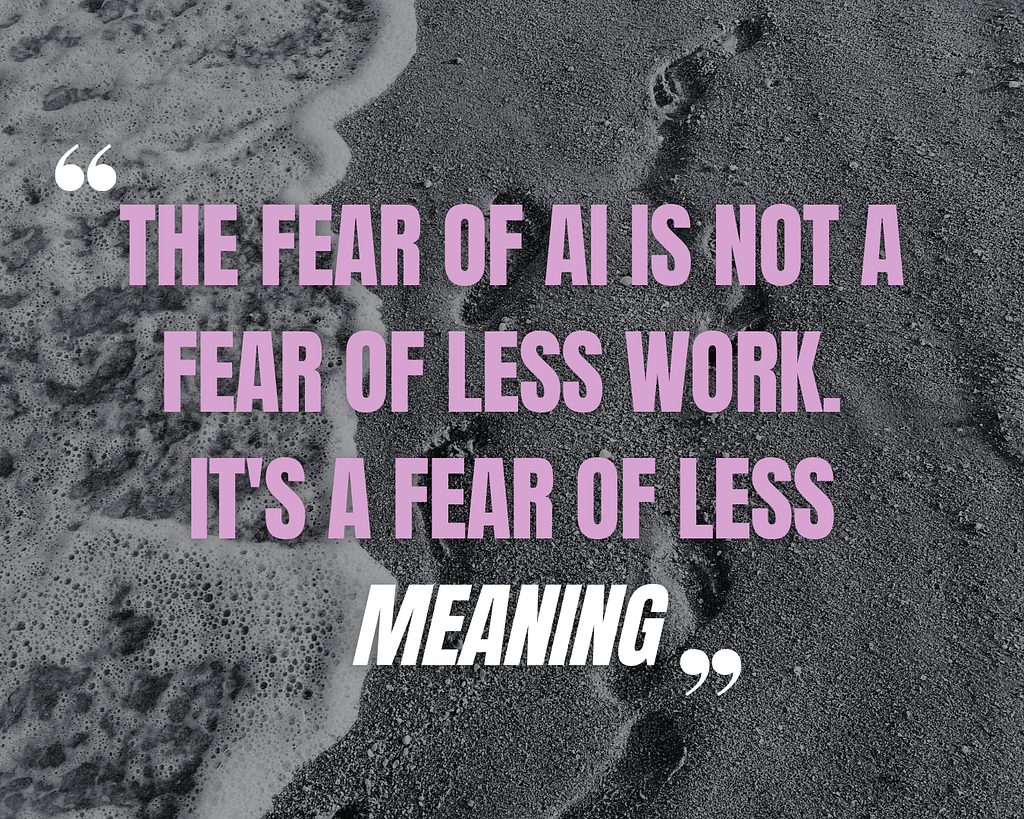
Because what they fear is not “less work.” What they fear is less meaning.
3. Change is inevitable. But losing yourself is not.
The episode also offered something grounding: a reminder that while change is non-negotiable, the way we navigate it is very much our choice.
No one needs to “embrace AI” overnight. No one needs to pretend enthusiasm. No one needs to deny what they feel.
What can help, though, is starting with very small, very human steps.
Step 1: Name what you feel.
Not the filtered version. The real one.
Is it fear? Anger? Sadness? Shame? Grief? Overwhelm?
Most people can name the tool they need before they can name the emotion they feel — but naming the emotion is the real beginning.
Step 2: Ask what the emotion is trying to protect.
Emotions are not enemies. They are guardians, they protect what we value.
For example:
- Anger often protects craftsmanship (“This is my art — don’t reduce it.”)
- Fear often protects mastery (“I worked so hard to get here.”)
- Sadness often protects meaning (“This work has been part of my life.”)
- Shame often protects competence (“I want to stay good at what I do.”)
Once you understand what the emotion is trying to defend, you begin to understand yourself, not AI.
You begin to see what truly matters to you — and what you want to carry into the future, no matter what changes.
Step 3: Make one small adjustment rooted in your values.
For some, it might be:
- delegating the parts of the work they never enjoyed
- using AI only for the admin pieces
- spending more time on the craft elements that truly matter
- redefining their role around oversight, creativity, or problem-solving
- reconnecting with the parts of the work that feel meaningful
This is how adaptation truly starts — with honest recognition of what is changing inside of us.
4. Meaning doesn’t disappear. It evolves.
This is the part we forget.
Meaning is not attached to one tool, one workflow, or one industry. Meaning comes from how we show up, what we value, and how we use our strengths to contribute.
Tools change. Industries shift. Crafts transform.
But meaning — real meaning — can be expressed in more than one form.
The craft is not gone. It is asking to be rediscovered.
A final thought
The fear of AI is not a fear of becoming redundant. It is a fear of losing the place where we’ve long felt most ourselves.
Understanding that fear is the first step toward shaping a future where our work still feels human, purposeful, alive.
And maybe — that’s the most important work we can do right now.
Ready to talk through your own transition?
Book a free 30-minute discovery call and let's explore what's next.
Book a Free Discovery CallFree Resource
Get the Career Pivot Playbook
A practical guide with 5 frameworks to help you navigate your next professional move with clarity and confidence.
The "Stay or Go" Decision Matrix
The 5 Signs You're Ready for a Change
The Career Clarity Framework
The Pivot Ladder & the 70% Rule
Your 7-Day Next Steps Action Plan
Download Your Free Guide
Enter your email and we'll send you the Career Pivot Playbook instantly.